

Milenko Prvacki’s Visual Dictionary & Construction Site series:
On building a visual lexicon
by Blythe Gay Min
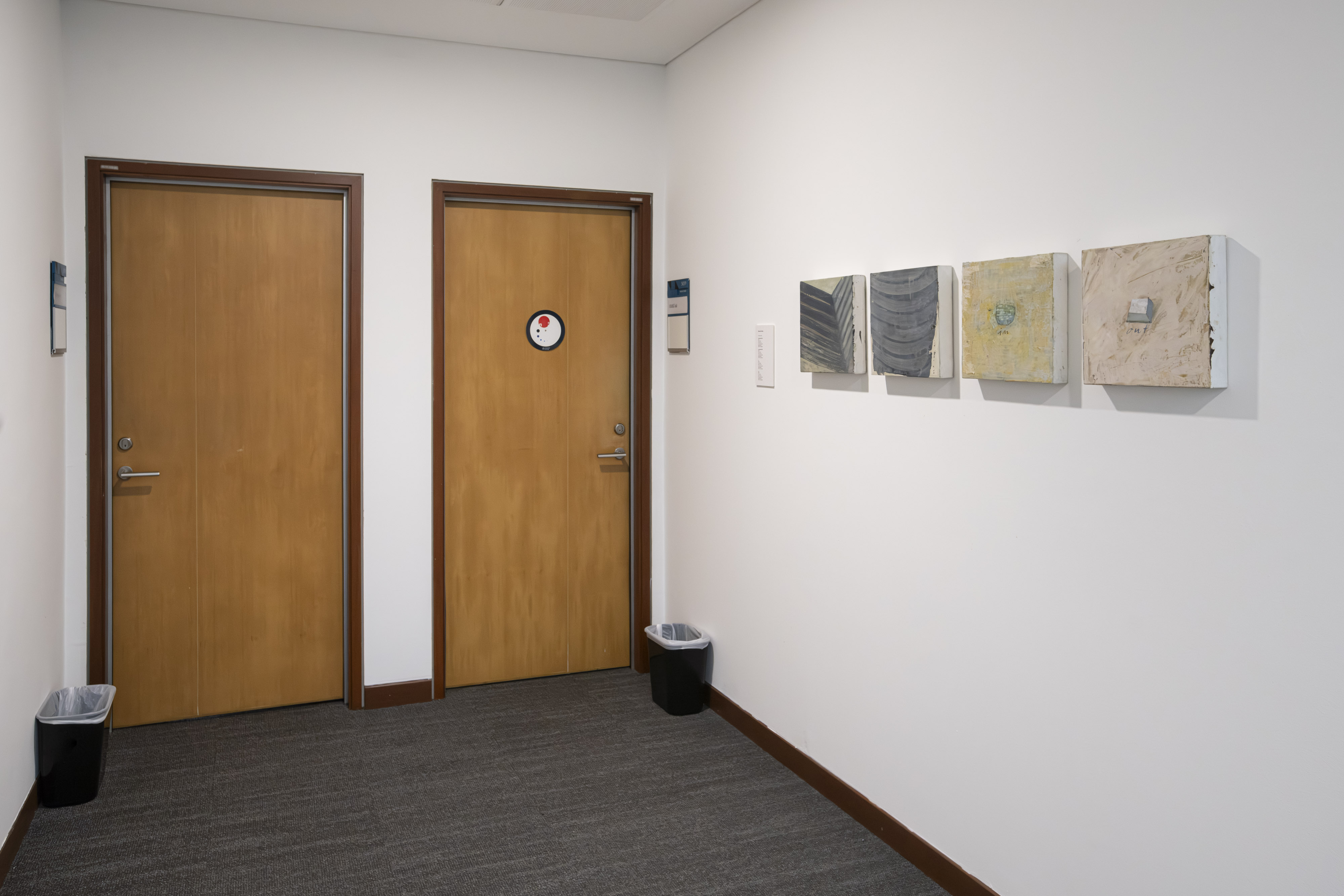
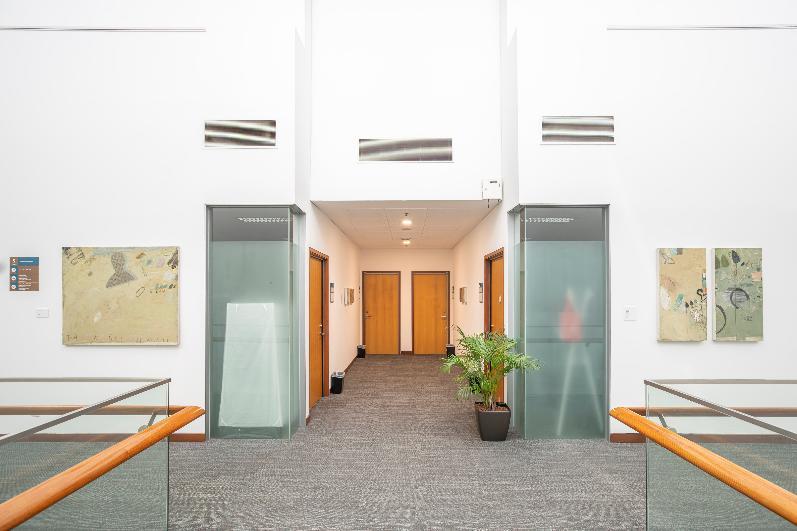
On the fifth-floor walls of SMU School of Economics is the Milenko Prvački Collection. The collection, comprising 43 artworks on loan from the artist, is composed of paintings from different series created by Prvački over two decades, from 1994 to 2014. The series of works included in the collection are Home, Methods and Materials, Construction Site, and Fragments. Amongst them, I am bringing into focus a particular series that introduced a visually new approach that allows for a more direct connection between the personal and the social. The Visual Dictionary is deliberated to be Prvački’s base infrastructure, a solid ground to build his new series upon. Below are traces of my own thoughts regarding Prvački’s artistic practice, alongside the connecting flow between Visual Dictionary and Construction Site.
Visual Dictionary
A dictionary contains knowledge—pre-established discovery of words and definite meanings are jotted down in this manual. But, it lacks narrative, it cannot be read in the same way a book can. Prvački fixates on this insight, using it as the core of his series. When asked if there was a reasoning behind the choice of a dictionary, he simply answered “The dictionary is my best friend.”
English was not Prvački’s mother tongue—it was Serbian. He was from former Yugoslavia, a country that no longer exists due to civil war, and is now succeeded by six republics, including Serbia. In 1991, after receiving a phone call from a former colleague who asked for help, Prvački moved to Singapore for two months. Eventually, with his contract extended, the Prvačkis took it as an opportunity to move and settle in Singapore all together. It was a sort of way to evade and seek refuge elsewhere from the brewing war going on in the former Yugoslavia. At the age of 40, Prvački had to learn a new language from scratch to survive and teach in a new foreign country. It is clear why there is an attachment to a dictionary.
Even with the relief that comes from escaping a dire situation, it was not easy moving forward. There was an underlying guilt that weighed on the Prvački family during their first few years in Singapore. Having no choice but to leave everything behind for their own chance at peace, they could not help but picture what their loved ones were experiencing.
Prvački was plagued with memories of a country that in time would cease to exist. Doubts subsequently linger in the form of questions: What specifically are memories? And would people care enough to listen to what does not affect them? In a way, memories are quite peculiar. They drift through our heads, crystal clear and coherent, but they can also appear in fragments, unclear and partial. Prvački channels this into Visual Dictionary, working to mold memory into a tangible form.
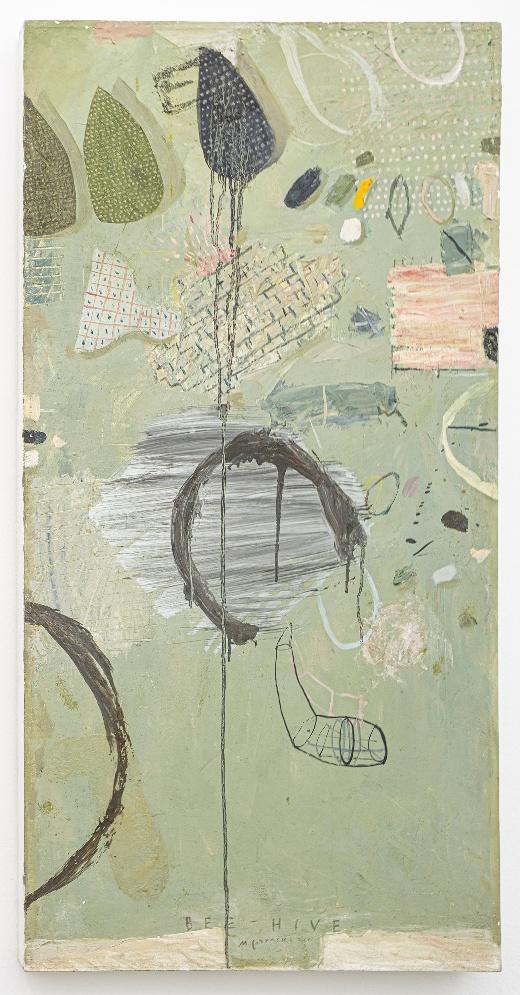
The paintings from the series Visual Dictionary are not meant to be seen as storytelling. It might be natural for the audience to try to dissect what Prvački drew in his paintings, albeit in vain. The dictionary does not exist as a narrative, it is purely a mix of notions. Prvački enforces this in his paintings, blending and experimenting with multiple obstructions.
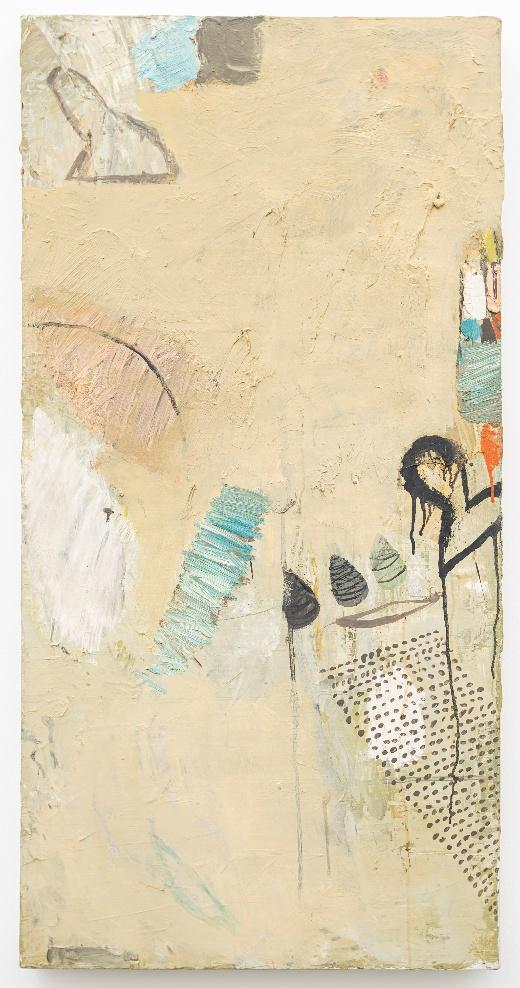
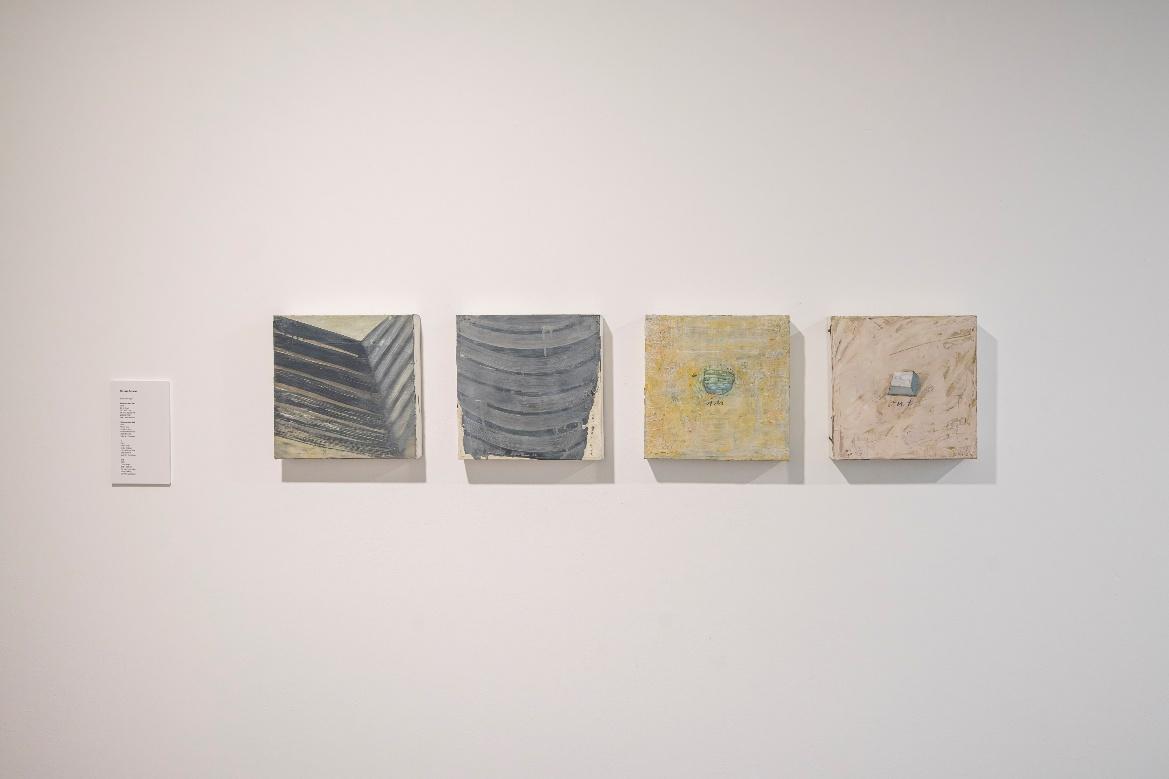
We can refer to the sand-coloured painting Visual Dictionary (2000) that is on display at the School of Economics. The abstract painting is dominated by a warm sand beige base, with a mix of soft muted tones nudged in throughout. Patches of aqua, orange, and black appear around, breaking up the neutral field and drawing the eye around the composition. Texture plays a major role in his artworks, the evidence is laid through loose, gestural strokes that wander throughout the canvas, and occasional placements of thick paint drops. Dots trail down in a slanted motion, alongside ink drips, which eventually blend in with the wave of sand beige. Situated in the middle, leaning right, stand three conic shapes, possibly a connection to another series featuring the recurring motifs of beehives and ideas of natural constructions.
Construction Site
When one door closes, another opens. Construction Site continues to fulfil Prvački’s vision and acts as an extension of Visual Dictionary. The term construction is often associated with words such as building and development. This makes it possible for local audiences to assume that this concept revolves around Singapore, as it was undergoing rapid construction. However, do not be misled, as this was not the original source of inspiration.
Prvački still meditates over the former Yugoslavia and the memories that skirt around it. In this instance, he uses shards of reality—lived experience, the physical environment, and social or political conditions—to build his own world. In the same way that individual words in a dictionary contribute to a larger system of meaning, this reality emerges from the careful selection and arrangement of images and ideas.
One of Prvački’s remarks that has lingered with me is his assertion that “nostalgia is a killer.” Reflecting on the complex nature of displacement, his works are known to be centred around it, using memories to form and construct his ideas. However, Prvački makes a clear distinction between memory and nostalgia. Memories provide insight and shape identity, mixing together our experiences to compare and move forward. Nostalgia, on the other hand, prevents one from making that motion. You tend to long for a past that cannot be recaptured, stuck with the feeling of temporariness and yearning to go back. It can be debilitating, as if you are in a constant loop. For Prvački, being able to embrace memories without falling into this ‘trap’ is key.
Through this series, Prvački continues to reflect on his long-standing interest in structure, process, and the act of building. I would also like to link this back to another series Brickyard, which sparked a connection to Construction Site. In 1999, Prvački travelled to Rajasthan, India, accompanied by his wife Delia Prvački and several Singaporean artists. They encountered a brickyard, filled with intricate and skilled craftsmanship, leaving Prvački to be deeply influenced by the visible richness of traditional artisanal production. It was also fascinating to observe how knowledge can be transmitted across vast geographical distances, evident in Prvački’s observation of techniques resembling those of his grandfather’s village brickyard in Europe. Embodying these findings, he began to engage more deeply with the idea of relationships—particularly between human-made structures and natural forms, such as beehives. Naturally, these ideas round back to his closest companion, the Visual Dictionary, while also extending into further explorations, including the series Construction Site.
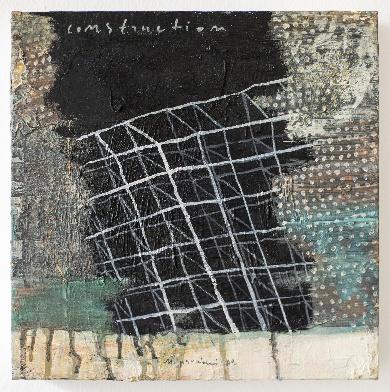
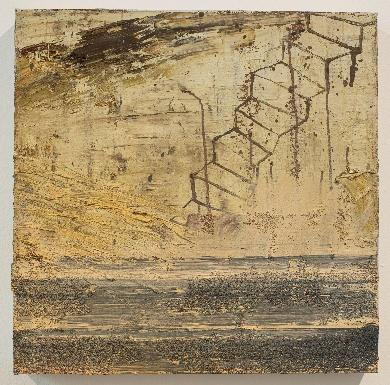
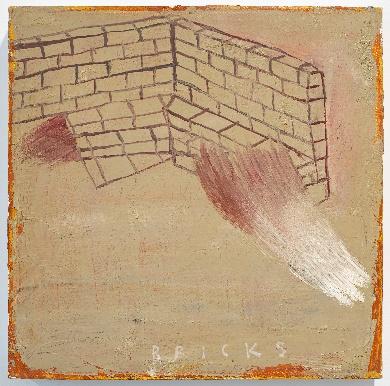
On a final note, let us return to a small painting, also on display at the School of Economics, Level 5, titled Construction Site (2004). At first glance, the painting is earthy and natural. Coarse splotches and strokes are dispersed around the square canvas, evoking grain and texture. The colours used make it feel almost gloomy. A staircase trails down vertically across the painting before eventually stopping midway, its tracks muffled up by the sea of rustic sand. Examining every tiny detail that weaves its way through the surface allows you to comprehend the amount of textural elements shown, making Prvački’s works very visually interesting.
About the writer
Blythe Gay Min is currently undertaking her Diploma in Fine Art at NAFA Nanyang Academy of Fine Arts, where she majors in painting. She interned with SMU Libraries, under the SMU Art Collection portfolio, from August to November 2025.