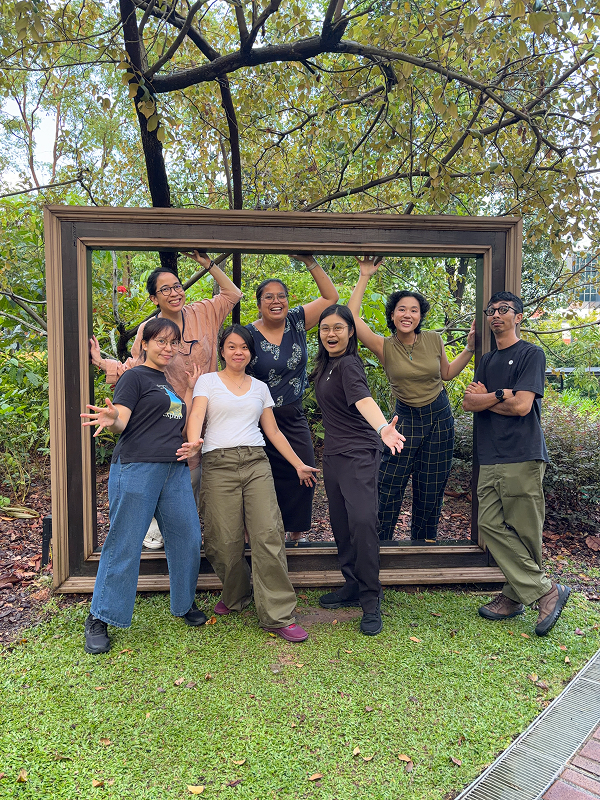

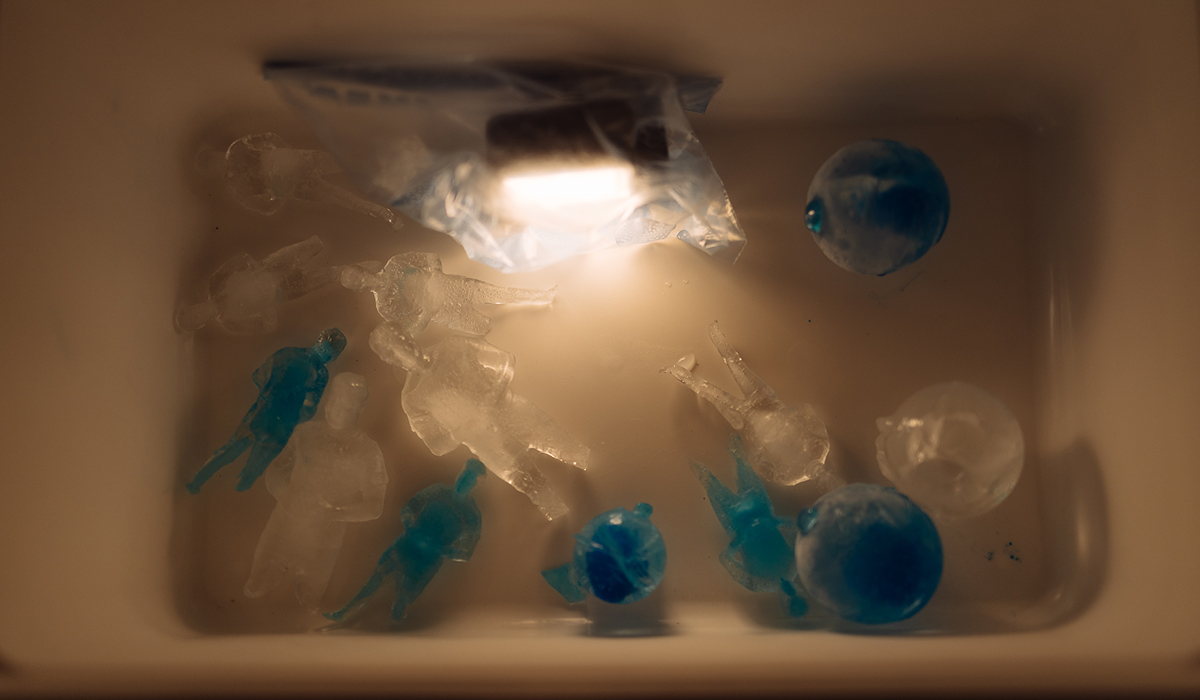
During her residency at SMU Libraries, from 5 January to 1 May 2026, interdisciplinary artist Elizabeth Mak collaborated with writer Cheyenne Alexandria Phillips and composer Syafiq Halid to develop t=d*s, a participatory audio night walk on Fort Canning Hill that interrogates the temporal conditions of late capitalism. The experience invites participants to descend into the vast, quiet scale of geological deep time, and reclaim time as a shared embodied resource through which new forms of meaning, agency, and ecological consciousness might emerge. SMU Libraries presented a work-in-progress showing from 21-26 April, which writer Raksha M. was invited to participate in as an interlocutor during the process and offer some reflection.
Walking the fort: speculative pasts and futures through deep time walks
By Raksha M.
“How the land has witnessed time has also changed.”
(t=d*s, 2026)
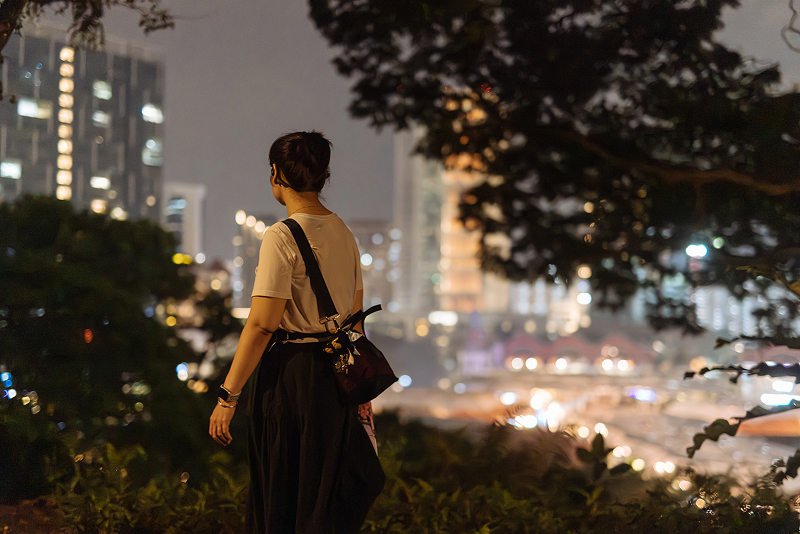
In muggy, dimming evening light, we gather around a campfire at the base of Bukit Larangan, or Fort Canning Hill, our backs to the throbbing sprawl of Clarke Quay. It has just rained. We can hear the directions and music piped in through the delivery mechanism of bone conduction earpieces without disconnecting from the ambient sounds of the environment, our facilitator explains. Instead of the more common in-ear or over-ear options, bone conduction audio sets sit just below the temple, in front of the ear. Our facilitator assures us they will be on hand to guide us if we get lost or go off path.
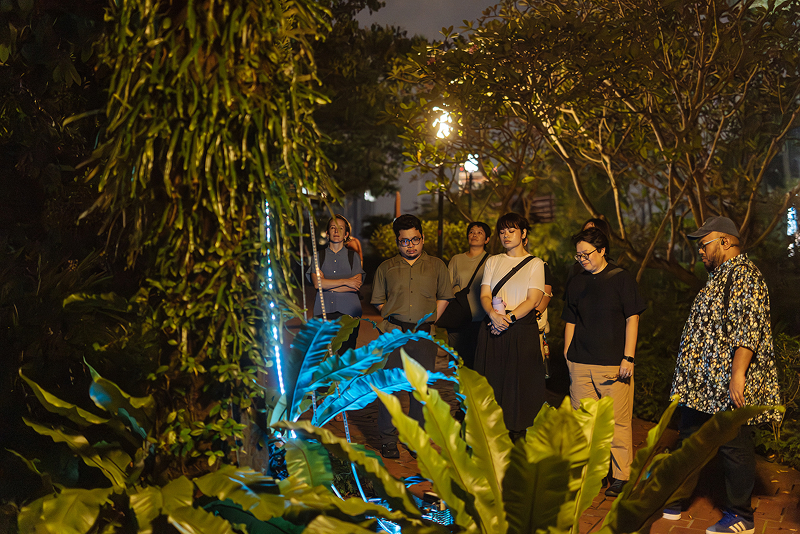
We are given directions to forage for an object and share why we selected it with the people nearest to us. They will be our companions and fellow pathfinders throughout this walk, but there isn't much time for introductions. In the dark grass, I reach for what looks like a tembusu flower (which I discover is a discarded tissue). We hazard uneasy descriptions of these objects. One of my companions on the walk cradles a dried leaf in his hand, while another points to a nearby boulder too unwieldy to carry. The conditions of intimacy we are usually bound by (like knowing the people around you) are suspended; here, we are invited to be and belong unconditionally, at least for the duration of this walk.
Elizabeth Mak’s work-in-progress, t=d*s, or time equals distance times speed, intentionally reinterprets the usual scientific formula (time = distance divided by speed). Her collaboration with experimental sound artist Syafiq Halid and environmental scientist and writer Cheyenne Alexandria Phillips informs the work’s thematic explorations. Together, they present a moving and absurd participatory and immersive piece about geological deep time, our relationships with climate and more-than-human worlds, and the parts we play in these.
This guideless tour takes the form of a performance score, drawing inspiration from Mak’s earlier work in choreography, and immersive, site-specific, and participatory theatre works created in collaboration with Third Rail Projects (New York, USA) and Albany Park Theatre Project (Chicago, USA), and in conversation with the work of theatre artist Geoff Sobelle’s (New York, USA). These companies and practitioners are known for theatre works such as Port of Entry (2024) (a collaboration between the former two), Learning Curve (2016) (another collaboration between the two), City of Boxes (2024), and Home (2017) respectively, which are often described along the spectrum of site-specific, immersive, experiential, and participatory works.
Participatory theatre as a form is not always immersive, and Mak’s work is remarkable for being both participatory and immersive. As a performance score using audio tour participants as actors, it mobilises a novel type of ecoscenography, putting ecological philosophies into practice through minimal performance and set design. This contrasts with her earlier work, Scarce City (2025) at National Gallery Singapore, an ecotheatre piece centred around a resource management escape room game within a 3D-printed recycled plastic set. In one of my conversations with Mak, she muses, “What does it mean to be a visual designer without building anything? I miss the ability to use just words, visuals, and sounds to sculpt an experience.” This ethic of care and sustainability in making climate responsive performance has surfaced in recent years.
In the wake of Matthew Schneider-Meyerson’s anthology, Eating Chili Crab in the Anthropocene (2020) and Esther Vincent Xueming and Angelia Poon’s collection Making Kin: Ecofeminist Essays from Singapore (2021), local ecotheatre offerings have bloomed wildly. The Theatre Practice’s hand in Pickle Party (2025) directs audiences to consider the consequences of their consumption practices and experiment with sustainable practices of food waste management. Drama Box’s Ubin (2022) invited participants on site-specific walks to consider the deeper history of the island and the residents of Singapore’s last kampung. The recent Esplanade showing of Food (2025) by Geoff Sobelle recasts audiences as cherished guests at a dinner party called to witness its only long-suffering host inhale and destroy everything in the room. Wild Rice’s Pulau Ujong / Island at the End (2022) surveys the breadth of lived experiences of the various eco-actors, including climate scientists, activists, and historians. The latter three also dwell on themes of inequality across nations, where the Global North pollution shapes some of the worst impacts seen in the tropics including South and Southeast Asia, hitting vulnerable communities such as migrants, refugees, and indigenous folk at the margins. Perhaps where Mak’s work-in-progress departs from is Ang Xiao Ting’s Extinction Feast (2022), which Mak worked on as a production designer, a spiralling dark comedy on information overload, climate anxiety, and hopelessness in the face of greater forces. Mak’s work responds to the paralysis induced by more didactic forms of storytelling, often too broadly global in their scope; instead her experiential work engages ecotheatrical practices to substantively explore greater possibilities of audience agency and action within local contexts that translate into participants’ lived experiences and relations with climate. The site of the work is no accident then, as the residency offers a proximity to the site of Fort Canning, or Bukit Larangan, and its many compressed layers of history. Her collaboration with artists like Cheyanne Alexandria Philips and Syafiq Halid works to activate often erased and forgotten nodes of deep time in place.
“[The koel] marks the sun’s trajectory, singing early in the morning and duetting with the dusk. The koel marks the equator’s way, circadian rhythm vocalised through the forest.” (t=d*s, 2026)
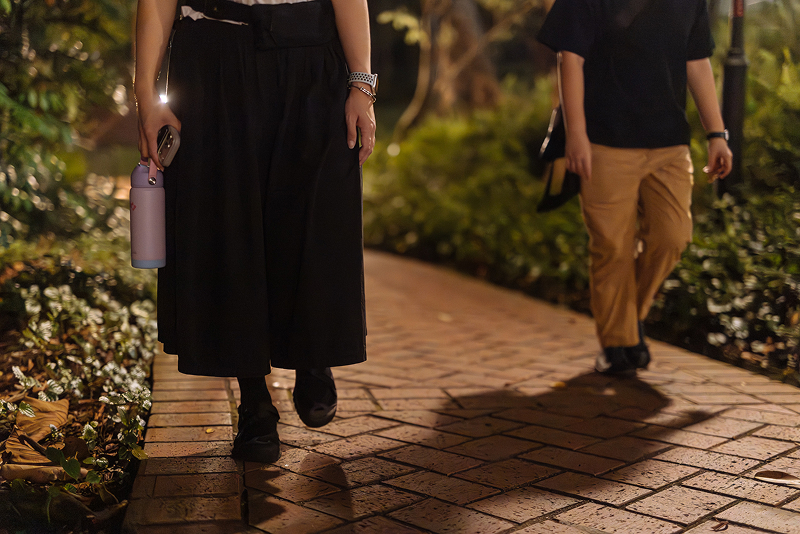
The audio system separates a group of participants from us, scattering them in all directions. Everyone is tuning in intently, trying to navigate their environment on differential motives. My group advances hesitantly along a red brick path. In our ears, Cheyenne’s poem about a koel scores live twilit sounds of uwu from the towering trees. A poet and playwright herself, her Checkpoint Theatre debut Playing with Fire (2024) dug into the complexities of petrochemical industry work and its workers through the lens of a young writer struggling to make sense of the on-the-ground realities against the ideals of a just energy transition.
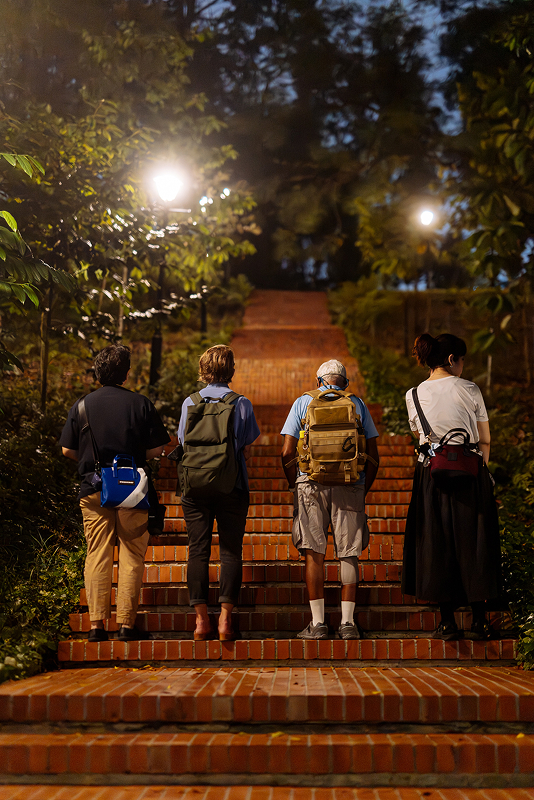
We arrive at a great staircase, probably 10 flights high, and are asked to imagine a timeline of the earth’s history at this very point. Take a step up and we have travelled 10 million years into the past, learning later the foundational stones of Fort Canning have taken form underneath us 100 million years ago. In tandem, we take another step up and 20 million years have passed. A jogger dodges our formation in the present and we all laugh at the awkward encounter. This moment, although unintentional, recalls what Sobelle says about laughter opening up an emotional space for experiencing something new. The paradox of live performance is that it creates the illusion of the present, rehearsed over and over. As we return our focus to the present performance of the past, we renew a shared commitment to the yawn of deep time.
We are asked to slow our speeds. Meditate on each step, cast our minds back to the first protohuman evolving bipedal motion, measure how far we have come since, not to take as a given the grace of our movement now. The evolution of human progress has escalated to a breakneck speed, enveloping lands, overwhelming species into mass extinctions. How many more will happen as we move forward? Each step feels too heavy all at once.
The paths of some in our group diverge, some meandering off along Five Kings Walk. Filing along with four others, we find ourselves at the top of one of the remaining buildings of Raffles House, overlooking a grand flight of stairs flanked by balustrades. We are handed out marching orders, building a rectangular conveyor belt of bodies climbing and descending the staircase. Some are evidently more nimble than others. I ignore the youth band nearby and focus on keeping breath and pace. In the shadow of the black and white bungalow, we form a sort of machine of colonial rule, complicit in reproducing its order and its violence. As we watch each other, it no longer feels like we are working together with our companions, but as if we are separated and competing to maintain the machine, indentured across tea estates and rubber plantations, mangrove filling projects and tiger hunting expeditions across South and Southeast Asia. The instructions in our earpieces chime again: we are asked to leave whenever we want. Can we? What of others who upheld colonial empires - what did resistance and pursuing their desires cost? One by one, we wander towards the lighthouse, and the machine breaks down.
In it,
“there is no vestige of a beginning, no prospect of an end.” (t=d*s, 2026)
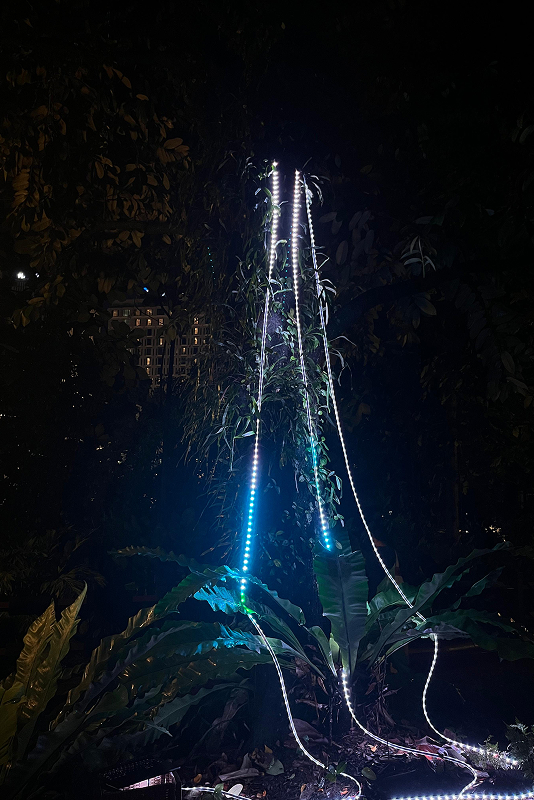
We pass by a neon light sculpture installation around a tree, hearing voices and deepening drums via the audio set. From the grass patches where lovers and friends picnic waft languages from the region: Burmese, Thai, Bahasa Indonesia. Here, en route to the Sang Nila Utama or Artisan’s Garden, Syafiq Halid’s electric compositions take centre stage, summoning sonic languages, images, and ethics of Nusantara cultures. We hear interlaced fragments of found sound, nightjars and hawk-owls (live or recorded, I couldn’t tell), Malay traditional percussion like rebana, kompang, hadrah, and jidur alongside the weighty synths and polyrhythms of electronica. Syafiq’s earlier work comes to mind here. In his recent work, The Space Remembers You (2025) at ArtScience Museum, a collaboration with P7:1SMA artistic director and Malay folk dancer Norhaizad Adam, loops and resonances offer a ritual of returning and of summoning unseen spirits and presences lingering within a space. The ethos of his earlier works echoes here, especially of jaga diri - a gentle caution to witness the past, to deconstruct the powerful structures of the present, to foray into another’s space with respect and care.
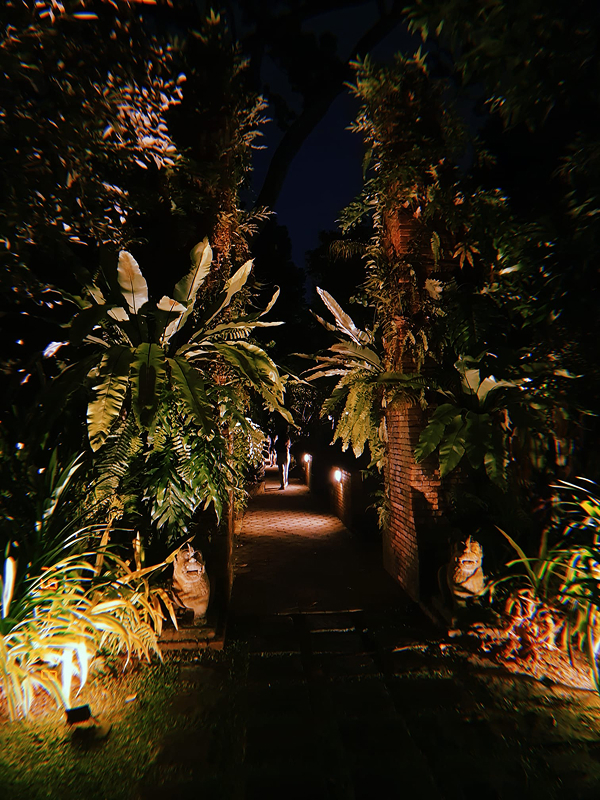
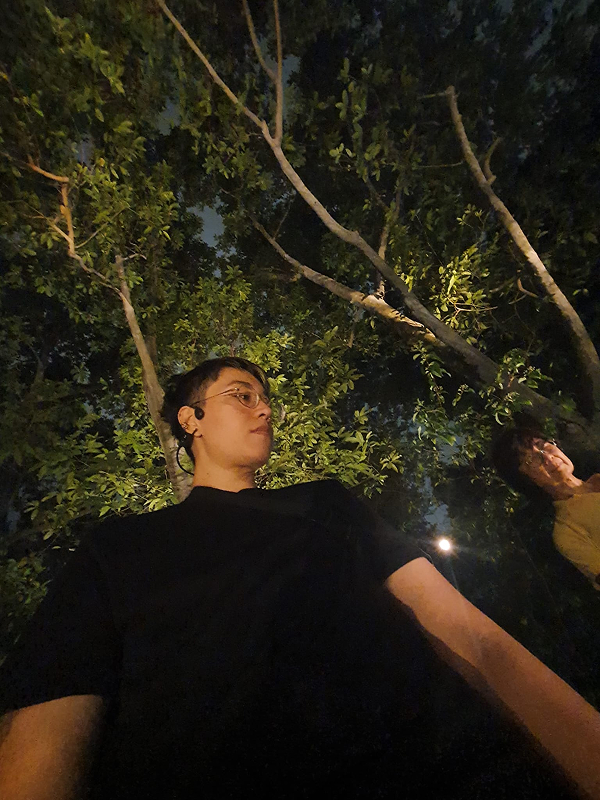
We pass through the split gates of a Javanese-inspired garden, flush with ferns, waterlilies, cinnamon, and clove. The garden was once the living quarters and workshop of royal craftsfolk, accessible even to common people. Archaeological studies of the area have revealed Malay artefacts of ceramics, gold, glass, iron, resin and charcoal that describe the focus of their craft and the dominance and wealth of their patrons.
We are asked on reaching a clearing to step up onto square stone seats clustered in groups of four and look down. We imagine that the ground has become a dark sea, flooding the once connected land mass of Sundaland and creating a scattering of archipelagoes. Malaysia, Indonesia, Brunei, Singapore, Papua New Guinea, connected by an immense seabed and millions of marine residents. We are called to gently consider these ancient connections through an ethic of care and place. We look at each other, standing on the seats an arm’s length away, maybe a day’s travel across our imaginary seas. Perhaps in this gesture of returning to land through deep time, borders and all the accoutrements of nationhood seem distant theories.
“There is a tale of Pulau Luang, Indonesia. Once there was a single unbroken island, shattered by the betrayal of brothers. One brother called upon Putri Laut, the ocean queen, who sent a powerful sailfish to cut through the island with his massive fin, fracturing it into a million pieces.” (t=d*s, 2026)
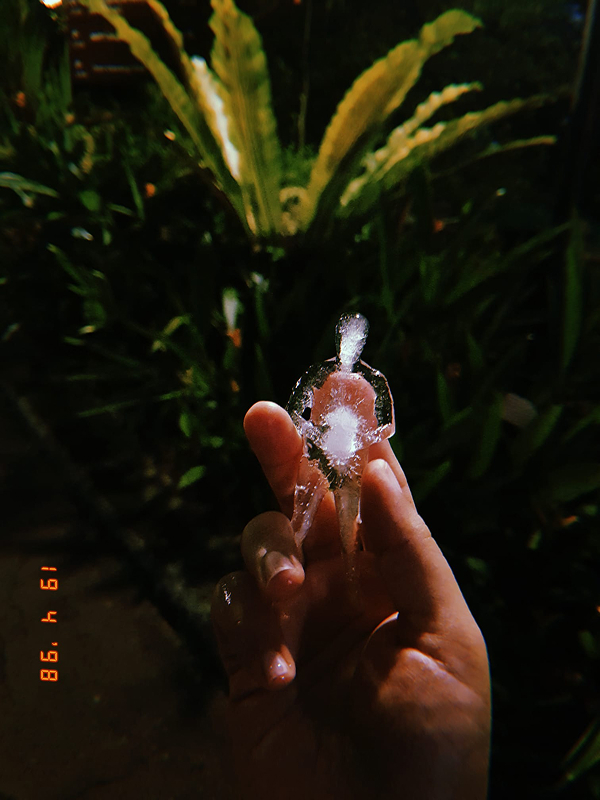
On and on, we walk as the air grows still and the vegetation around us, a thick shroud. We reach the Keramat Sultan Iskandar Shah, the sacred and revered tomb of the last Malay King. As we pause, we form a loose congregation, our hands intuitively cast in the shapes of prayer to various powers that be. We are asked to offer the objects we chose at the beginning of the walk. I will not offer the tissue I mistook for a flower, wishing him instead a rain of petals.
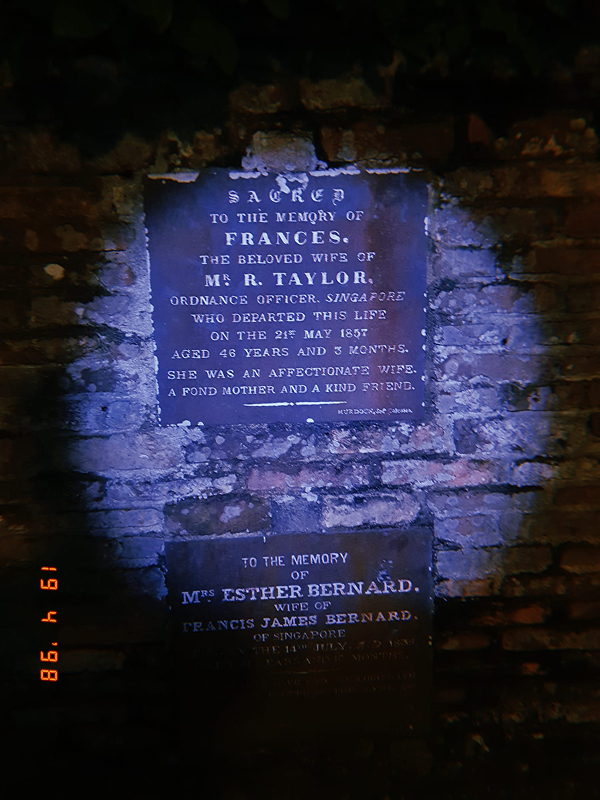
Death and its grieving bears on our minds, as again we are cast onto the labyrinthine paths towards Fort Canning Green. More requests shiver against our jaws through the audio sets: switch on your flashlights, file along the walls and find an embedded tombstone. My light lingers over the sparse description of women’s graves, labelled loving mothers and doting wives. What else were their lives? At least their passings were marked, a sign of privilege for the time. I think of the unwitnessed lives of the people who attended to them: servants, craftsfolk, barbers, shoe shiners, letter writers. So commonly occupied by picnics and concerts, the lawn is now quiet and undulating, the breeze slightly floral. Maybe we are less alone in our grief than we imagine.
We meet again at a massive banyan lit like a stage, and walk around it, keeping pace with our fellow participants. We stop and look up. Through the bone conduction headsets, a list poem unfurls. Cast your lights up to the sky, the instructions nudge us, see yourselves as part of the constellations above, letting your light live where you do. Go dance in the dark where no one can see you, if you like.
I peel off from the group, swinging off of pondok structures and lamp poles. The momentum pulling me forward is pleasing. What shall I do with this self of mine in this interminable amount of time? I find a small clearing near the low wall on the other side of the green, where I used to crouch with my friends as a teenager during concerts we couldn’t afford. We are left with Syafiq’s music, a tentative soundtrack for this freedom. Hands trace shapes, feet lift, and I close my eyes. I am eighteen again. Mak’s work concludes in one last request. Our facilitator reappears, handing out blank letters and envelopes so that we may document this experience and any commitments we might want to make to our future self. I am eighteen. I am thirty-eight. I am sixty-eight. I wonder what the ground under my feet will feel like then, in this very spot. I wonder where my feet might have gone, what score my hands might have made. Do we disappear helplessly into the polyrhythms and loop voids, or do we remember a body and an autonomy only ours to shape?
About the writer
Raksha M. is a researcher, writer, and facilitator. Their research work focuses on intimate labour, social inequality, friendship, and urban studies in Singapore. They are a long-time volunteer with Project X Society. Outside of work, they are an enjoyer of theatre, movement work, rock climbing, dancing on their own, and losing sight of the trees for the monsoon-bathed forests beyond.